November 2, 2026
Choosing a School – Accepted but Unprepared: How VCS Builds Real College Readiness
A student can earn strong grades, complete advanced math courses, graduate from high school, and gain admission to a respected university, only to discover that he or she was never truly prepared for college-level work. That is not a hypothetical concern. It is happening right now, and the evidence should cause every parent to look more carefully at what a high-school diploma and transcript actually represent.
The College Investor recently reported that both fall sections of UC San Diego’s lowest-level mathematics course were full, with another 175 students reportedly waiting for a seat. This is not a typical college math class. UC San Diego redesigned Math 2 to address gaps reaching back into elementary and middle-school mathematics, and the course does not count toward the credits required for a bachelor’s degree. Students are paying college tuition to relearn material they should have mastered years before arriving on campus.
That headline is startling. The official data behind it are even more concerning.
Strong Grades Do Not Always Mean Real Readiness
According to UC San Diego’s own Senate-Administration Workgroup on Admissions, approximately 11.8% of its entering class in fall 2025 placed into Math 2 or Math 3B, courses created for students who had not mastered the mathematics expected of incoming UC students. Roughly one in twelve entering students tested below middle-school math standards.
These were not simply students with poor high-school records. More than 25% of the students placed into Math 2 [remedial math] had earned a 4.0 average in their high-school math courses. Among students testing below middle-school standards, 94% had taken math beyond the minimum required for UC admission. Many reported completing statistics, precalculus, or calculus.
The problem extends well beyond one university:
Measure | What the Latest Data Show |
UC San Diego | Approximately 11.8% of the fall 2025 entering class placed below expected high-school math preparation, with roughly one in twelve entering below middle-school standards. |
Only 16.24% of California eleventh graders met or exceeded the state mathematics standard in 2025. | |
Forty-five percent of American twelfth graders performed below NAEP Basic in 2024, the highest percentage reported on the current trend line. | |
ACT College Readiness | Only 30% of ACT-tested graduates in the Class of 2025 met at least three of the four ACT College Readiness Benchmarks. |
The conclusion is unavoidable. California (and America, for that matter) does not simply have a college-admissions problem. We have a college-readiness problem.
The Better Question for Families
Families have been trained to focus on GPAs, graduation rates, advanced course titles, and college-acceptance lists. Those things matter, but they do not tell the full story. A course title does not guarantee rigor, an A does not necessarily prove mastery, and an acceptance letter does not confirm that a student is prepared to succeed once the work begins.
The better question is not simply, “Will this school help my child get into college?” Families should ask whether teachers will know when their child is struggling, whether academic gaps will be identified early, whether grades reflect real learning, and whether students have access to both advanced opportunities and personal support.
Families deserve more than general statements about academic excellence. They deserve a school that can explain how students are known, measured, challenged, supported, and prepared.
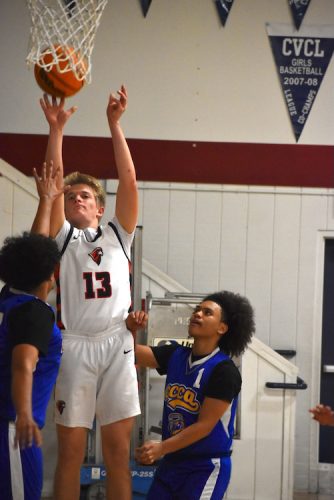
Students at VCS have every opportunity to pursue collegiate athletics, and in some important ways, they may have an even better path. They can compete at a high level while receiving individual mentorship, academic guidance, recruiting resources, and personal support from coaches and staff who actually know them.
How VCS Builds Real Readiness
At Vacaville Christian High School, our goal is not simply to help students accumulate credits and build an attractive transcript. We are preparing students to succeed in the work, responsibilities, and opportunities that follow graduation. That requires rigor, honest measurement, strong relationships, and adults who know each student personally.
Our high-school classes average approximately 13 to 14 students. Students cannot quietly disappear into the back of a crowded classroom. Teachers recognize when a student is confused, disengaged, underperforming, or capable of more, and they provide regular academic support and tutoring throughout the week.
VCS also believes academic excellence should be measurable. Across our school, we use the nationally normed Iowa assessment to understand how students are performing compared with students across the country, not merely whether they crossed a California-defined proficiency line. VCS students perform above national norms overall, and we use those results to identify gaps, evaluate strengths, and improve instruction.
College preparation begins early. VCS students participate in PSAT testing beginning in eighth grade, and each student receives individualized academic and college counseling with parents included throughout the process. Students have access to 14 Advanced Placement courses, including AP Calculus AB, AP Calculus BC, and AP Statistics.
In 2025, VCHS was recognized as a College Board AP School Honor Roll Gold School. Only 7% of eligible schools in the United States and Canada earned Gold recognition that year. In 2024, VCHS earned the College Board’s highest AP School Honor Roll distinction, Platinum, placing it among just 2% of eligible high schools across California to achieve Platinum recognition.
VCS students do not have to choose between personal attention and serious academic opportunity. They receive both.
Academic Excellence Is Christian Formation
As a Christian school, we believe truth matters. We do not serve students by giving them grades that conceal gaps or moving them forward before they are ready. Grace does not mean lowering standards. It means knowing students well, telling them the truth, supporting them when the work becomes difficult, and helping them grow. Academic excellence is part of Christian formation – at VCS, strong academics, character, wisdom, and faith are not separate goals.
The crisis unfolding in college mathematics should change how families evaluate high schools. A polished transcript is not enough. Students need real knowledge, durable skills, personal guidance, and an honest understanding of their readiness.
At VCS, students are known, challenged, supported, and prepared. That is the VCS difference.
Take a Closer Look at VCS Academics
Also Read: Article – Choosing a School: How VCS Academics Measure Up
Also Watch: Podcast – VCS Academics

Blog Archives: View past blog posts here.